# Overview
> Set up webhook notifications, verify their signatures, and test your integration.
A webhook is an HTTP request that notifies your server when an event occurs. Chunkify sends a JSON payload to your webhook URL for each event you subscribe to.
For example, the `asset.playback_ready` event tells your application when the HLS stream becomes playable.
The video asset may still be `preparing`, with its poster and timeline previews not yet available.
`asset.ready` means playback, the poster, and timeline previews are all ready. Subscribe to it as well if your application needs those additional URLs.
## Set up a webhook in the dashboard
1. In your Project, open **Developers → Webhooks → Setup webhook**.
2. Enter your server's **Webhook URL**, choose an event group such as **Assets**, and select the events your application needs. Then select **Create webhook**.
3. Copy the **Webhook secret** from the Webhooks page. Your server uses it to verify incoming notifications.
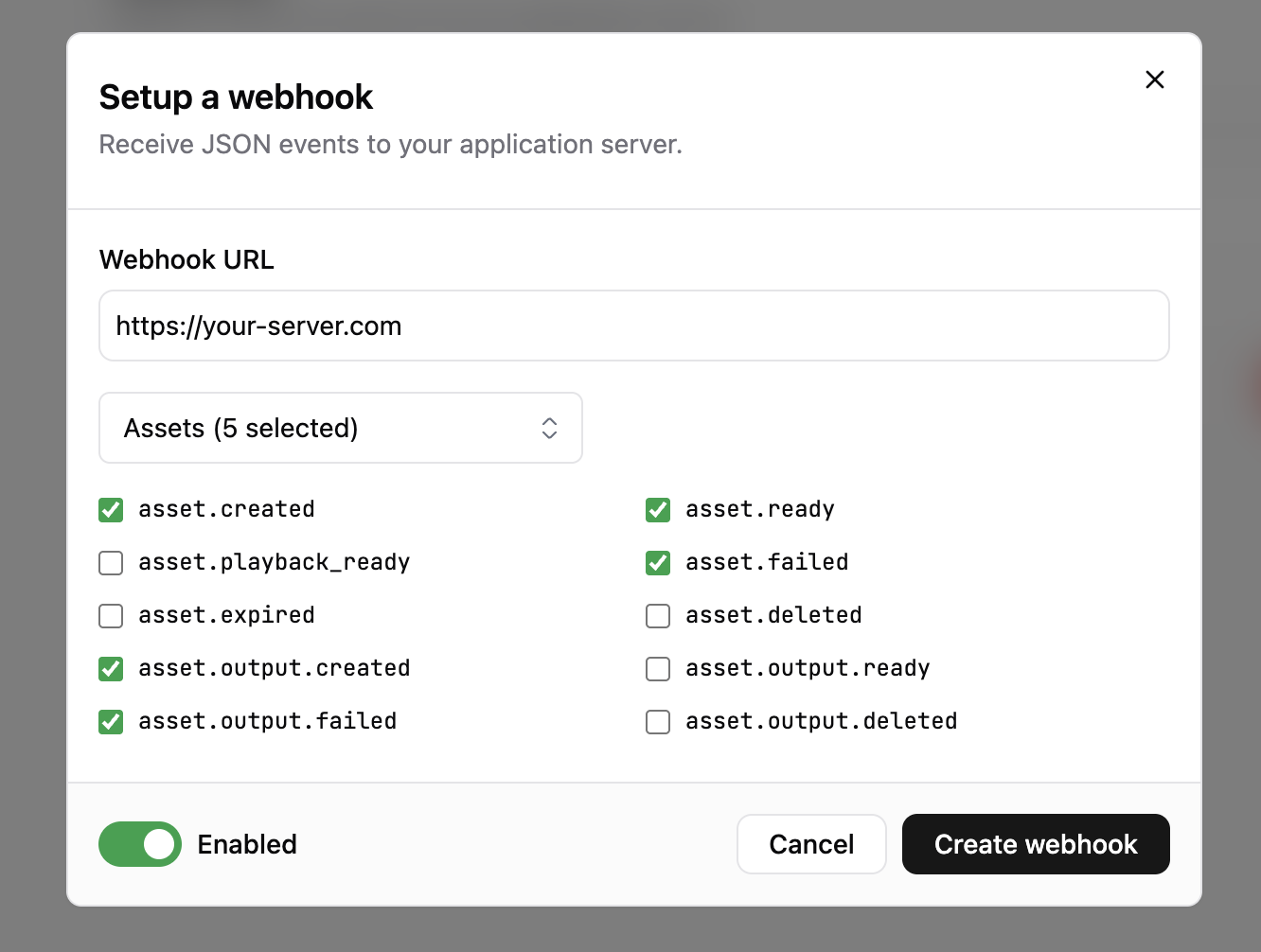 The webhook is enabled by default. Select `asset.playback_ready` to receive a notification as soon as the HLS stream is playable, or `asset.ready` when you also need the poster and timeline previews.
## Set up a webhook with the SDK
Set `events` to the types your application needs. This example subscribes to `asset.playback_ready` so your server is notified when the HLS stream becomes playable.
```typescript
import Chunkify from '@chunkify/chunkify';
const client = new Chunkify({
projectAccessToken: 'My Project Access Token',
});
// Create a webhook
const webhook = await client.webhooks.create({
url: 'https://example.com/webhook',
events: ['asset.playback_ready'],
});
```
```python
from chunkify import Chunkify
client = Chunkify(
project_access_token="My Project Access Token",
)
# Create a webhook
webhook = client.webhooks.create(
url="https://example.com/webhook",
events=["asset.playback_ready"],
)
```
```php
use Chunkify\Client;
$client = new Client(
projectAccessToken: 'My Project Access Token',
);
// Create a webhook
$webhook = $client->webhooks->create(
url: 'https://example.com/webhook',
events: ['asset.playback_ready'],
);
```
```go Go
package main
import (
"context"
"fmt"
"github.com/chunkifydev/chunkify-go"
"github.com/chunkifydev/chunkify-go/option"
)
func main() {
client := chunkify.NewClient(
option.WithProjectAccessToken("My Project Access Token"),
)
webhook, err := client.Webhooks.New(
context.Background(),
chunkify.WebhookNewParams{
URL: "https://example.com/webhook",
Events: []string{"asset.playback_ready"},
},
)
if err != nil {
panic(err)
}
fmt.Println(webhook.ID)
}
```
If you omit `events`, Chunkify subscribes the webhook to all supported events except `asset.playback_ready`. Subscribe to it explicitly to receive playback notifications.
## Event history
Chunkify records every [supported event](/docs/integration/events#supported-events), even when no webhook is configured.
For each subscribed webhook, Chunkify creates a notification and records its delivery attempts. Creating a webhook does not send past events.
## Verify webhook signature
Chunkify signs notifications according to the [Standard Webhooks specification](https://github.com/standard-webhooks/standard-webhooks/blob/main/spec/standard-webhooks.md).
Verify the signature before processing a notification. Use your Webhook secret, the raw request body, and the `webhook-id`, `webhook-timestamp`, and `webhook-signature` headers.
The raw request body is the JSON exactly as received, before your framework parses it. Parsing and re-encoding it can change the bytes and make signature verification fail.
These examples verify the signature and handle `asset.playback_ready`. Replace the example secret with your Project's Webhook secret.
```typescript Typescript
// This example uses Express for simplicity
import express from 'express';
import type { RequestHandler } from 'express';
import Chunkify from '@chunkify/chunkify';
const app = express();
const PORT = 8787;
// Use raw body for signature verification
app.use(express.raw({ type: 'application/json' }));
const webhookHandler: RequestHandler = (req, res) => {
const headers: Record = {
'webhook-signature': req.header('webhook-signature') || '',
'webhook-id': req.header('webhook-id') || '',
'webhook-timestamp': req.header('webhook-timestamp') || '',
};
const client = new Chunkify({
projectAccessToken: 'My Project Access Token',
webhookKey: 'your secret key',
});
// Unwrap the webhook will also verify the signature using the secret key
let notification: Chunkify.UnwrapWebhookEvent;
try {
notification = client.webhooks.unwrap(req.body.toString(), { headers });
} catch (error) {
console.error('Error unwrapping webhook:', error);
res.status(400).send('Error unwrapping webhook');
return;
}
const event = notification.event;
console.log('Webhook event received:', event);
switch (event) {
case 'asset.playback_ready':
const payload = notification.data as Chunkify.UnwrapWebhookEvent.NotificationPayloadAsset;
console.log(`Video asset ${payload.asset.id} can play`);
break;
// Complete with other cases for other event type as needed.
default:
console.log(`Unexpected event type: ${event}`);
}
res.status(200).send('OK');
};
app.post('/webhook', webhookHandler);
app.listen(PORT, () => {
console.log(`Test server listening on http://localhost:${PORT}`);
});
```
```python Python
"""Webhook server using Python's built-in http.server."""
from http.server import HTTPServer, BaseHTTPRequestHandler
import json
from chunkify import Chunkify
from chunkify.types import UnwrapWebhookEvent
PORT = 8787
# Initialize client with webhook key for signature verification
client = Chunkify(
webhook_key="your secret key",
)
class WebhookHandler(BaseHTTPRequestHandler):
"""Handle webhook requests."""
def do_POST(self): # noqa: N802
"""Handle POST requests to /webhook."""
if self.path != "/webhook":
self.send_response(404)
self.end_headers()
return
# Read raw body
content_length = int(self.headers.get("Content-Length", 0))
payload = self.rfile.read(content_length).decode("utf-8")
# Extract webhook headers
headers = {
"webhook-signature": self.headers.get("webhook-signature", ""),
"webhook-id": self.headers.get("webhook-id", ""),
"webhook-timestamp": self.headers.get("webhook-timestamp", ""),
}
# Unwrap the webhook (also verifies the signature)
try:
notification: UnwrapWebhookEvent = client.webhooks.unwrap(payload, headers=headers)
except Exception as error:
print(f"Error unwrapping webhook: {error}")
self.send_response(400)
self.send_header("Content-Type", "application/json")
self.end_headers()
self.wfile.write(json.dumps({"error": "Error unwrapping webhook"}).encode())
return
# Get the event type
event = notification.event
print(f"Webhook event received: {event}")
# Handle different event types
if event == "asset.playback_ready":
print(f"Video asset {notification.data.asset.id} can play")
else:
print(f"Unexpected event type: {event}")
# Send success response
self.send_response(200)
self.send_header("Content-Type", "application/json")
self.end_headers()
self.wfile.write(json.dumps({"status": "OK"}).encode())
def log_message(self, format, *args): # noqa: N802
"""Suppress default logging."""
pass
if __name__ == "__main__":
server = HTTPServer(("localhost", PORT), WebhookHandler)
print(f"Test server listening on http://localhost:{PORT}")
try:
server.serve_forever()
except KeyboardInterrupt:
print("\nShutting down server...")
server.shutdown()
```
```php PHP
use Chunkify\Client;
use Chunkify\Core\Exceptions\WebhookException;
$client = new Client(
webhookKey: 'your secret key',
);
$body = file_get_contents('php://input') ?: '';
$headers = array_change_key_case(getallheaders() ?: [], CASE_LOWER);
try {
// Unwrapping the webhook also verifies its signature
$notification = $client->webhooks->unwrap(
$body,
[
'webhook-signature' => $headers['webhook-signature'] ?? '',
'webhook-id' => $headers['webhook-id'] ?? '',
'webhook-timestamp' => $headers['webhook-timestamp'] ?? '',
],
);
switch ($notification->event) {
case 'asset.playback_ready':
printf("Video asset %s can play\n", $notification->data->asset->id);
break;
default:
error_log("Unexpected event type: {$notification->event}");
}
http_response_code(200);
echo 'OK';
} catch (WebhookException $error) {
error_log('Error unwrapping webhook: ' . $error->getMessage());
http_response_code(400);
echo 'Error unwrapping webhook';
}
```
```go Go
package main
import (
"fmt"
"io"
"net/http"
"github.com/chunkifydev/chunkify-go"
"github.com/chunkifydev/chunkify-go/option"
)
func handleWebhook(w http.ResponseWriter, r *http.Request) {
client := chunkify.NewClient(
option.WithWebhookKey("your secret key"),
)
// Read the request body
body, err := io.ReadAll(r.Body)
if err != nil {
http.Error(w, "Error reading request body", http.StatusBadRequest)
return
}
// Unwrap the notification payload
notification, err := client.Webhooks.Unwrap(body, r.Header)
if err != nil {
http.Error(w, "Error unwrapping webhook", http.StatusBadRequest)
return
}
switch notification.Event {
case chunkify.UnwrapWebhookEventEventAssetPlaybackReady:
data := notification.Data.AsUnwrapWebhookEventDataNotificationPayloadAsset()
fmt.Printf("Video asset %s can play\n", data.Asset.ID)
default:
fmt.Printf("unexpected event type: %s\n", notification.Event)
}
}
func main() {
// Register the webhook handler
http.HandleFunc("/webhook", handleWebhook)
// Start the server
port := ":8787"
fmt.Printf("Webhook server listening on http://localhost%s/webhook\n", port)
if err := http.ListenAndServe(port, nil); err != nil {
fmt.Printf("Server failed to start: %v\n", err)
}
}
```
Return a `2xx` response after accepting a notification. Chunkify retries failed deliveries, so make your handler safe to run more than once for the same event.
## Testing your webhook integration locally
Use the Chunkify CLI to forward notifications to your local server. See [Receive webhook notifications locally](/docs/cli/integration#receiving-webhooks-notifications-locally) for the setup steps.
## Manually send a notification
You can send a notification to a specific webhook to retry a failed delivery or test your handler. When a matching event is retained, Chunkify uses its saved payload.
Provide `webhook_id`, `event`, and the `object_id` of the resource that produced the event. For `asset.playback_ready`, use the video asset ID.
Notification attempts are limited to five for the same event and webhook. See [Create a notification](/docs/api-reference/notifications/create-a-notification) for the full request and response.
```typescript
import Chunkify from '@chunkify/chunkify';
const client = new Chunkify({
projectAccessToken: 'My Project Access Token',
});
const notification = await client.notifications.create({
event: 'asset.playback_ready',
object_id: 'ast_2G6MJiNz71bHQGNzGwKx5cJwPFS',
webhook_id: 'wh_2G6MJiNz71bHQGNzGwKx5cJwPFS',
});
```
```python
from chunkify import Chunkify
client = Chunkify(
project_access_token="My Project Access Token",
)
notification = client.notifications.create(
event="asset.playback_ready",
object_id="ast_2G6MJiNz71bHQGNzGwKx5cJwPFS",
webhook_id="wh_2G6MJiNz71bHQGNzGwKx5cJwPFS",
)
```
```php
notifications->create(
event: 'asset.playback_ready',
objectID: 'ast_2G6MJiNz71bHQGNzGwKx5cJwPFS',
webhookID: 'wh_2G6MJiNz71bHQGNzGwKx5cJwPFS',
);
```
```go
package main
import (
"context"
"fmt"
"log"
"github.com/chunkifydev/chunkify-go"
"github.com/chunkifydev/chunkify-go/option"
)
func main() {
client := chunkify.NewClient(
option.WithProjectAccessToken("My Project Access Token"),
)
notification, err := client.Notifications.New(
context.TODO(),
chunkify.NotificationNewParams{
Event: chunkify.NotificationNewParamsEventAssetPlaybackReady,
ObjectID: "ast_2G6MJiNz71bHQGNzGwKx5cJwPFS",
WebhookID: "wh_2G6MJiNz71bHQGNzGwKx5cJwPFS",
},
)
if err != nil {
log.Fatal(err)
}
fmt.Printf("%+v\n", notification)
}
```