Benchmarks
Chunkify vs AWS Elemental MediaConvert Benchmarks
Chunkify vs AWS MediaConvert for H.264, HEVC, and AV1 transcoding.
This page includes benchmarks that compare the performance, cost, and quality of Chunkify with AWS Elemental MediaConvert for video transcoding workloads, along with all of the resources needed to reproduce these results. We measure transcoding speed, cost, and output quality across multiple codecs and resolutions to provide a comprehensive comparison.
Note: All benchmarks were run using production-ready configurations without service-specific optimizations to bias results. AWS MediaConvert used default QVBR in auto mode (per-title encoding), while Chunkify used Per-chunk encoding.
Benchmark configuration
All benchmarks described here were run with the following configuration:
| Service | Configuration | Encoding Strategy | Pricing Model |
|---|---|---|---|
| Chunkify | 8 vCPU x 13 (104 vCPU) | Per-chunk encoding | vCPU-seconds consumed |
| AWS MediaConvert | On-demand | QVBR auto (per-title encoding) | On-demand pricing |
- Chunkify configuration: Each job uses 13 instances, each with 8 vCPUs (104 vCPU total). This parallelization capability is a key architectural advantage that allows Chunkify to process video segments concurrently, significantly reducing transcoding time.
- Chunkify FFmpeg encoders: H.264 uses
libx264, HEVC useslibx265, and AV1 useslibsvtav1. - AWS MediaConvert: Processes jobs sequentially without user-configurable parallelization options.
- Configuration: All other settings left at each platform's defaults, except for codec and resolution parameters which are specified per test.
- Test execution: All jobs executed sequentially (one at a time) to measure pure transcoding performance without queue effects.
- Region: All tests run in
us-east-1to ensure fair comparison.
Source asset
All benchmarks use the same input file to ensure consistent comparison:
Tears of Steel is a 12 minute 14 second (734 seconds) 4K movie from the Blender Foundation. The source resolution is 3840 × 1714, file size is 6.27 GB, with an average bitrate of roughly 70 MB per second.
This asset provides a challenging test case due to its length, high bitrate, and film grain, which stress encoders across all codecs.
Public source file:
https://ftp.nluug.nl/pub/graphics/blender/demo/movies/ToS/tearsofsteel_4k.mov
Note: This file has been uploaded to our S3 bucket to produce these benchmarks.
Methodology
This benchmark focuses on operational efficiency, measuring full transcoding execution time and pure transcoding cost.
Timing: Wall clock time from when transcoding begins until outputs are finalized. Queue time is excluded.
Cost: Reflects transcoding charges only. Storage, data transfer, and other fees are not included.
Test matrix: Each codec, including H.264, HEVC, and AV1, is tested at three resolutions: 1280 × 572, 1920 × 858, and 3840 × 1714. The aspect ratio is preserved from the source.
Quality comparison: Chunkify uses Per-chunk encoding, while AWS uses QVBR auto. The quality tables report observed mean VMAF, file size, and derived average bitrate; the two encoding strategies are not bitrate-matched.
VMAF methodology: Mean VMAF was calculated using Netflix's 4K VMAF model (vmaf_4k_v0.6.1). For every resolution, the distorted output was upscaled with bicubic interpolation to 3840 × 1714 to match the 4K reference before scoring. The results therefore represent quality after upscaling to the 4K comparison resolution rather than quality measured at the output's native encoded resolution.
Average bitrate: Bitrate is derived from each reported file size using the 734.919-second encoded-output duration and rounded to the nearest kb/s.
Codec benchmarks
Benchmarks are grouped by codec to keep performance, cost, and quality together for each encoding profile. For performance and cost, lower is better. Chunkify uses Per-chunk encoding and AWS uses QVBR auto (per-title encoding) in all tests.
H.264
Performance
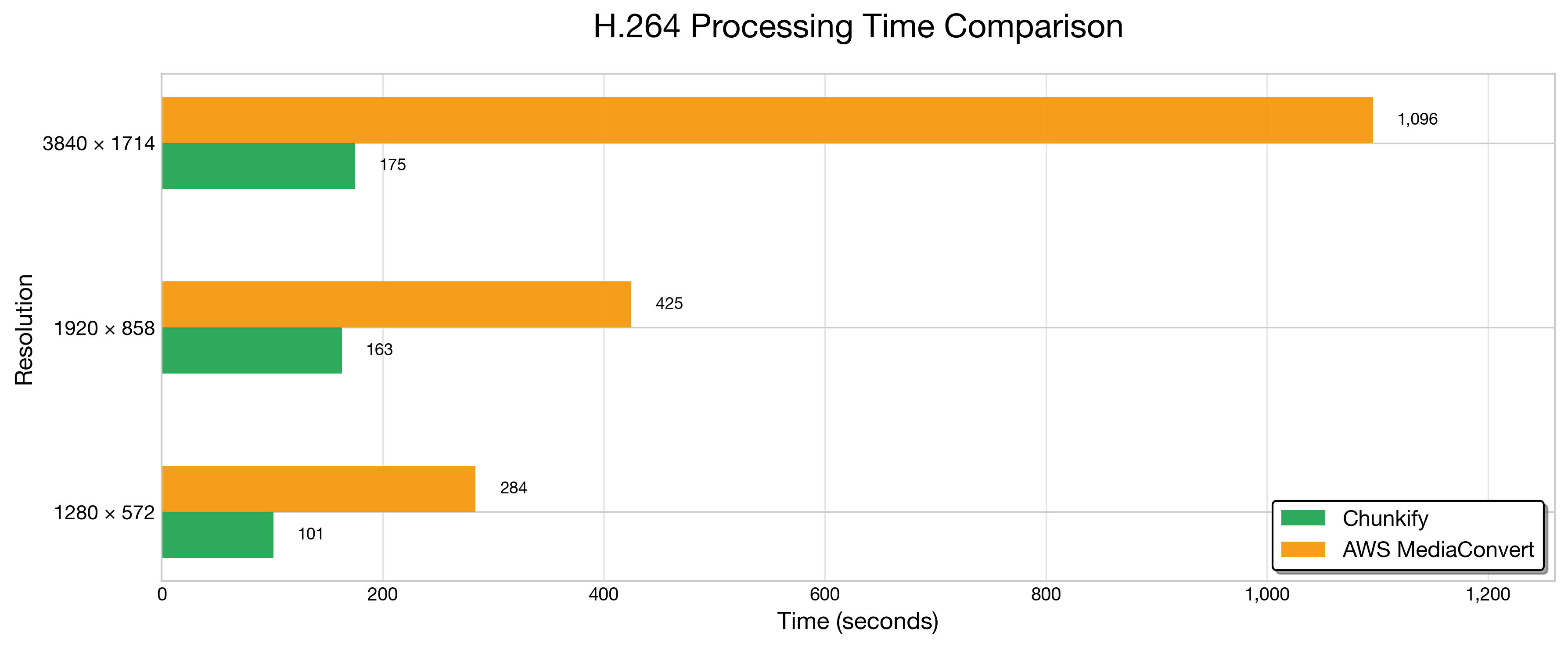
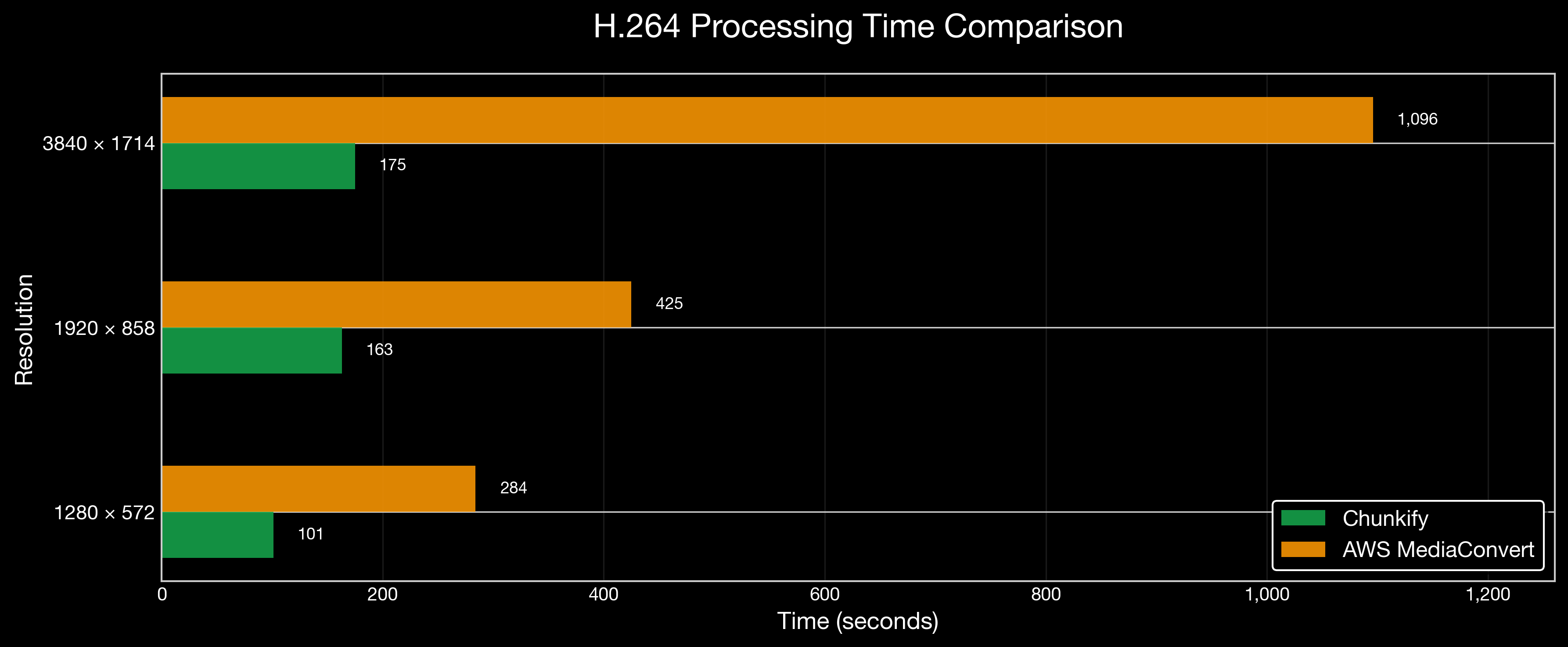
H.264 transcoding shows Chunkify completing jobs 2.61x to 6.26x faster than AWS MediaConvert:
| Resolution | Chunkify time (s) | AWS time (s) | Speedup |
|---|---|---|---|
| 1280 × 572 | 101 | 284 | 2.81x |
| 1920 × 858 | 163 | 425 | 2.61x |
| 3840 × 1714 | 175 | 1,096 | 6.26x |
Cost
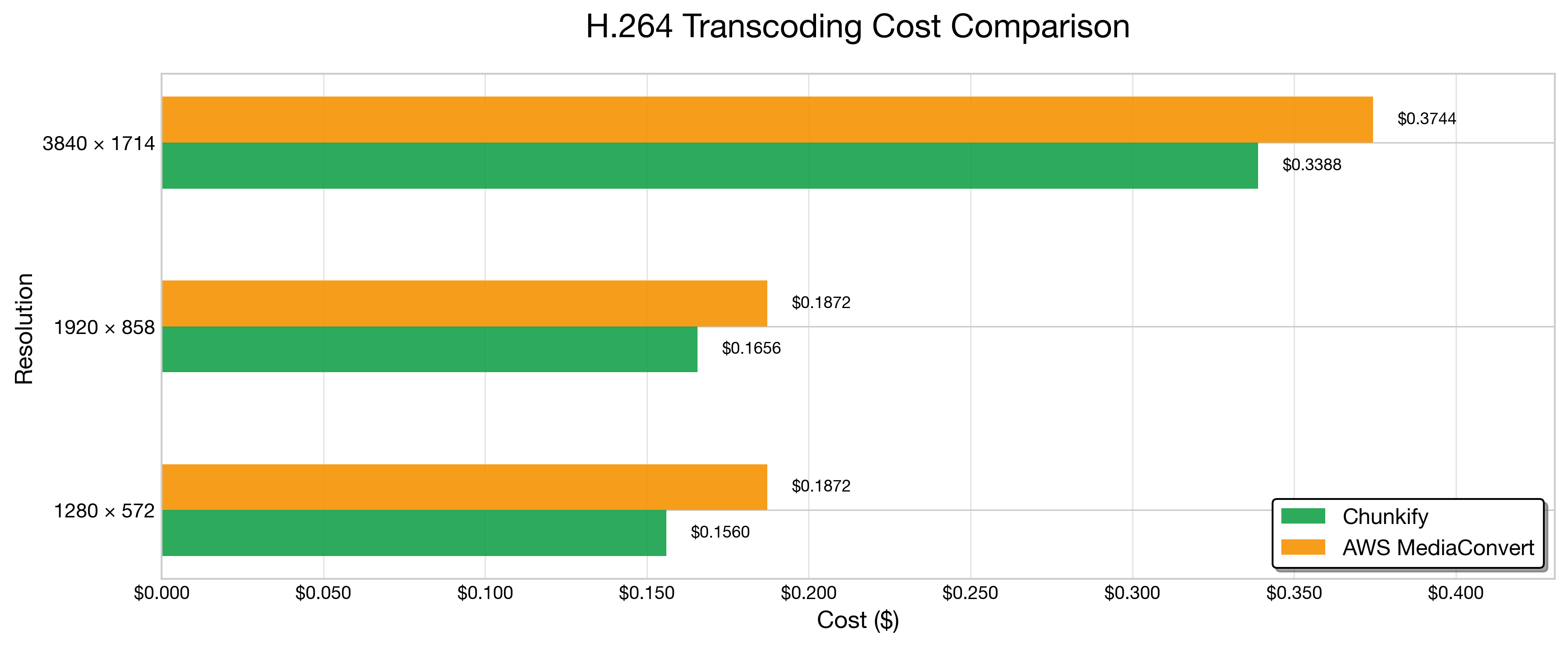
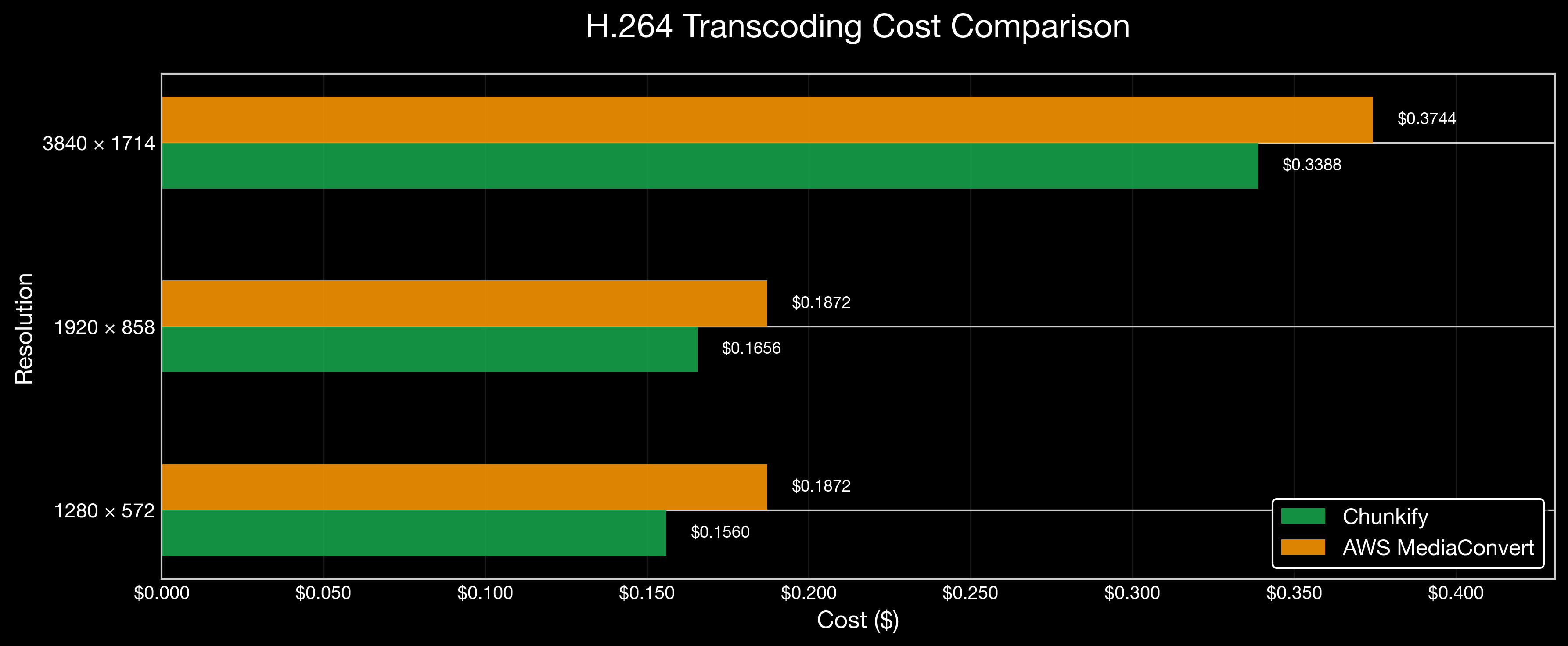
Chunkify costs 10% to 17% less for H.264 transcoding:
| Resolution | Chunkify cost ($) | AWS cost ($) | Cost savings |
|---|---|---|---|
| 1280 × 572 | $0.1560 | $0.1872 | 1.20x cheaper (17%) |
| 1920 × 858 | $0.1656 | $0.1872 | 1.13x cheaper (12%) |
| 3840 × 1714 | $0.3388 | $0.3744 | 1.10x cheaper (10%) |
Quality
| Resolution | Chunkify size (MiB) | Chunkify average bitrate (kb/s) | Chunkify mean VMAF | AWS size (MiB) | AWS average bitrate (kb/s) | AWS mean VMAF |
|---|---|---|---|---|---|---|
| 1280 × 572 | 273.7 | 3,124 | 88.62 | 175.0 | 1,998 | 84.99 |
| 1920 × 858 | 475.6 | 5,429 | 93.50 | 563.0 | 6,426 | 94.17 |
| 3840 × 1714 | 1,077.1 | 12,294 | 96.58 | 1,536.0 | 17,532 | 97.63 |
Summary
H.264 shows a strong overall balance for Chunkify: it is consistently faster (2.61x to 6.26x) and cheaper (10% to 17%) than AWS. At 1920 × 858 and 3840 × 1714, Chunkify produces files that are 15.5% and 29.9% smaller, with mean VMAF within 1.05 points of AWS. At 1280 × 572, Chunkify scores 3.63 VMAF points higher with a larger output file.
HEVC
Performance
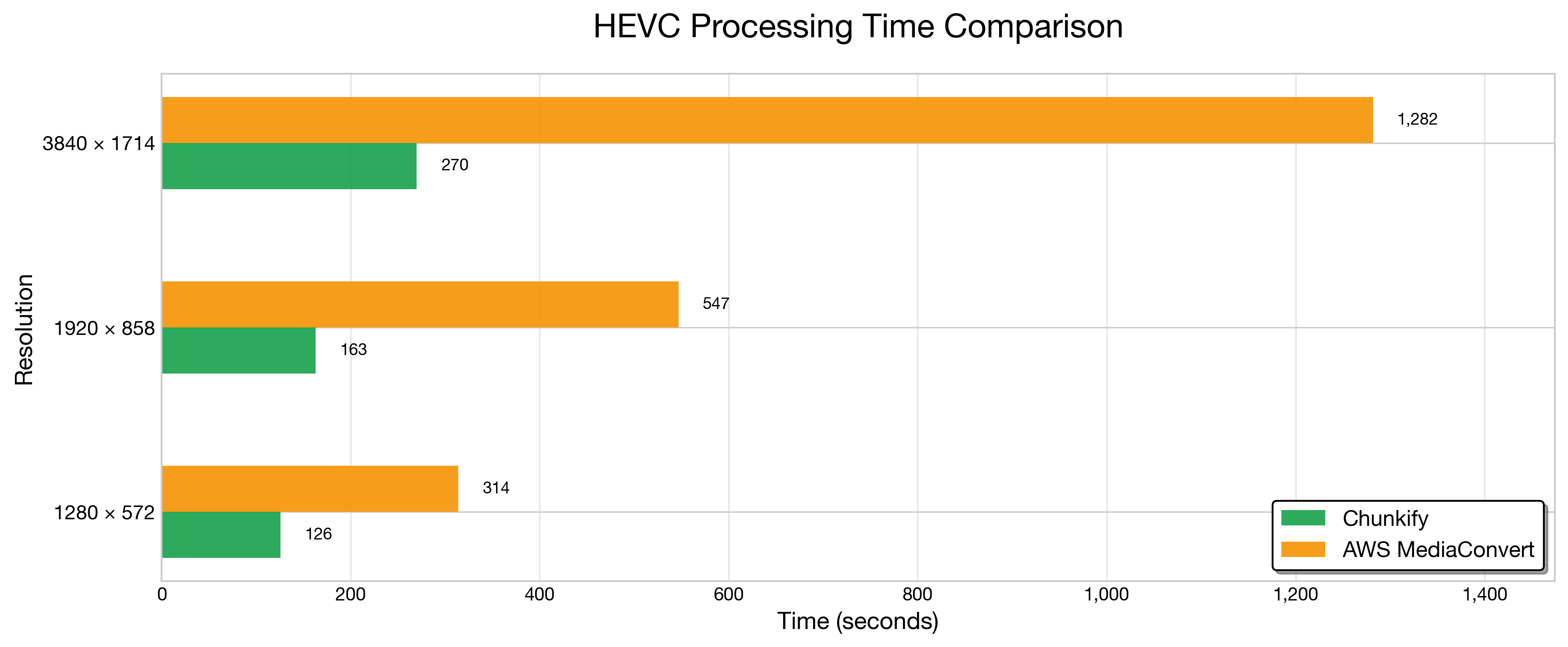
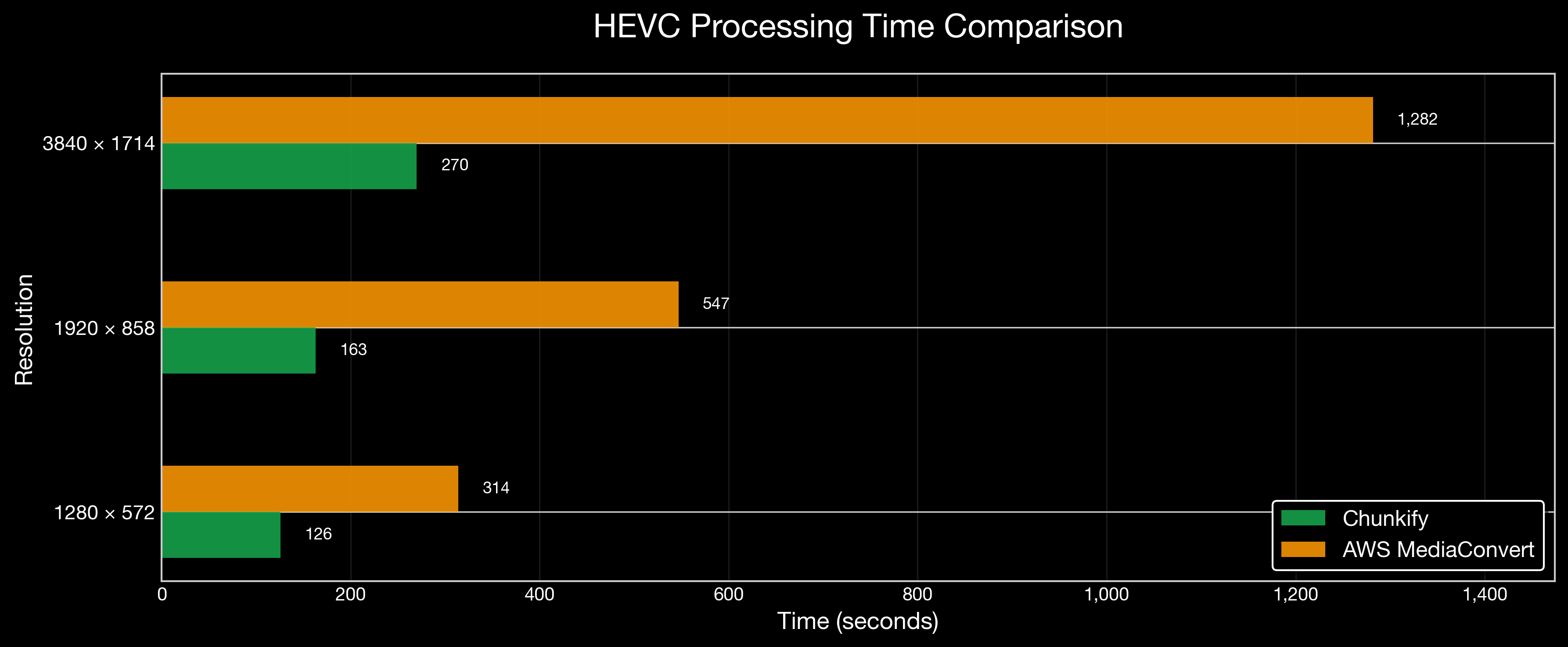
HEVC transcoding shows Chunkify performing 2.49x to 4.75x faster:
| Resolution | Chunkify time (s) | AWS time (s) | Speedup |
|---|---|---|---|
| 1280 × 572 | 126 | 314 | 2.49x |
| 1920 × 858 | 163 | 547 | 3.36x |
| 3840 × 1714 | 270 | 1,282 | 4.75x |
Cost
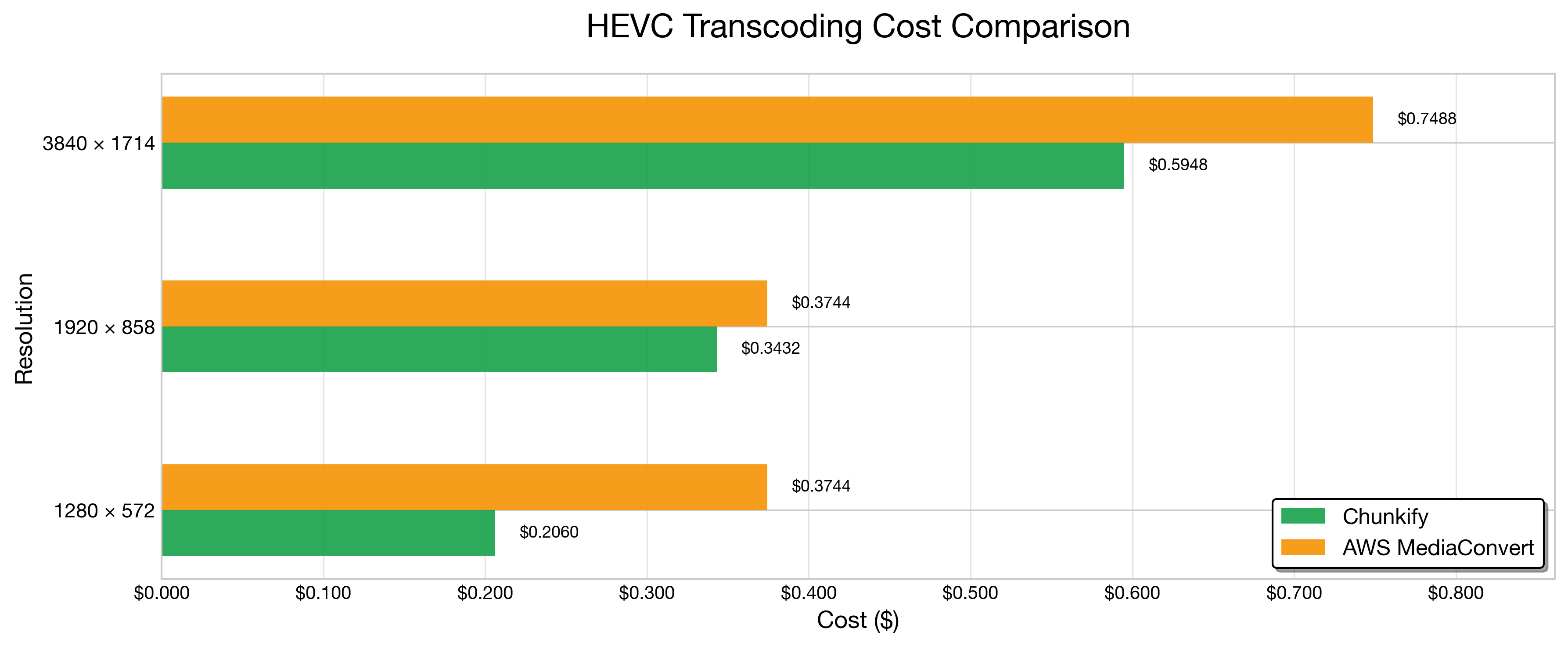
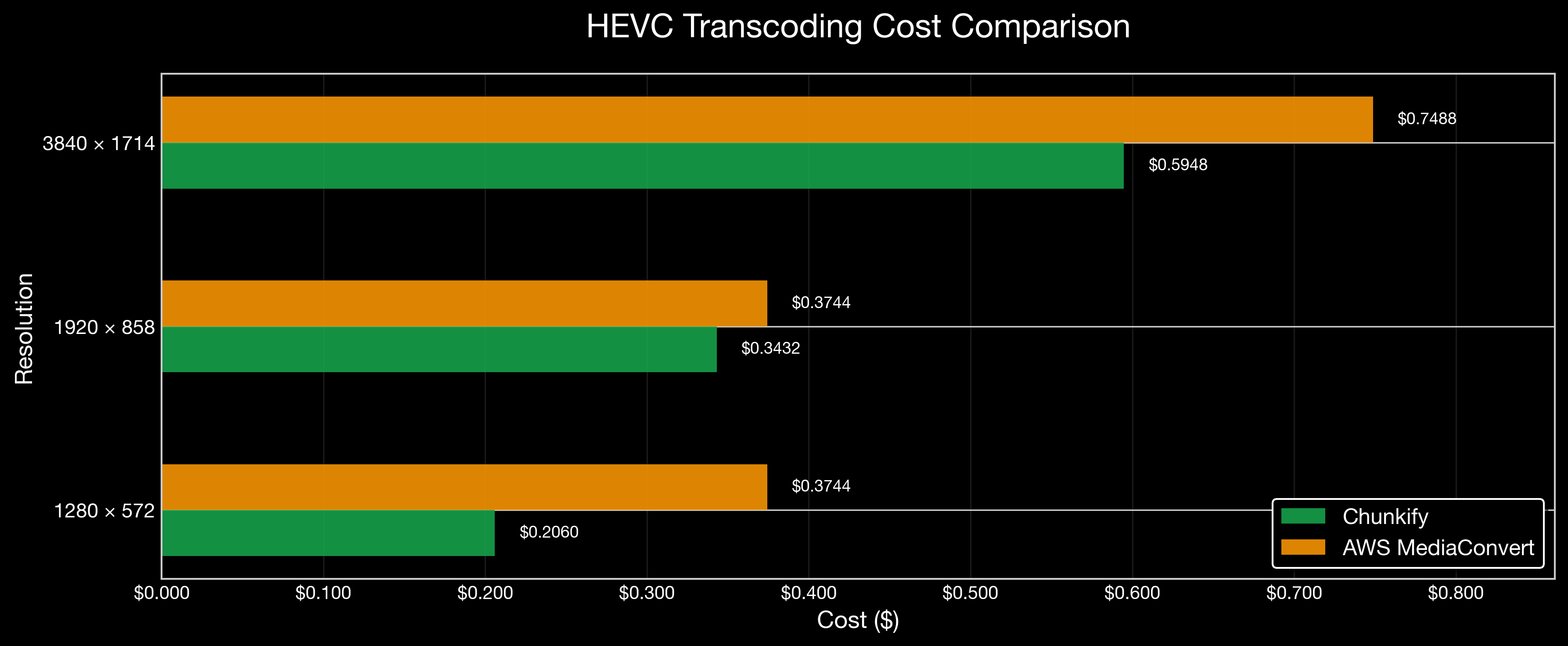
Chunkify costs 8% to 45% less for HEVC transcoding:
| Resolution | Chunkify cost ($) | AWS cost ($) | Cost savings |
|---|---|---|---|
| 1280 × 572 | $0.2060 | $0.3744 | 1.82x cheaper (45%) |
| 1920 × 858 | $0.3432 | $0.3744 | 1.09x cheaper (8%) |
| 3840 × 1714 | $0.5948 | $0.7488 | 1.26x cheaper (21%) |
Quality
| Resolution | Chunkify size (MiB) | Chunkify average bitrate (kb/s) | Chunkify mean VMAF | AWS size (MiB) | AWS average bitrate (kb/s) | AWS mean VMAF |
|---|---|---|---|---|---|---|
| 1280 × 572 | 219.1 | 2,501 | 88.62 | 248.0 | 2,831 | 88.50 |
| 1920 × 858 | 358.3 | 4,090 | 93.70 | 360.0 | 4,109 | 93.98 |
| 3840 × 1714 | 727.1 | 8,299 | 96.73 | 726.0 | 8,287 | 97.42 |
Summary
HEVC is consistently favorable for Chunkify: processing is 2.49x to 4.75x faster and cost is 8% to 45% lower. Mean VMAF remains within 0.69 points of AWS at every resolution; file size is 11.7% lower at 1280 × 572 and effectively equal at the two higher resolutions.
AV1
Performance
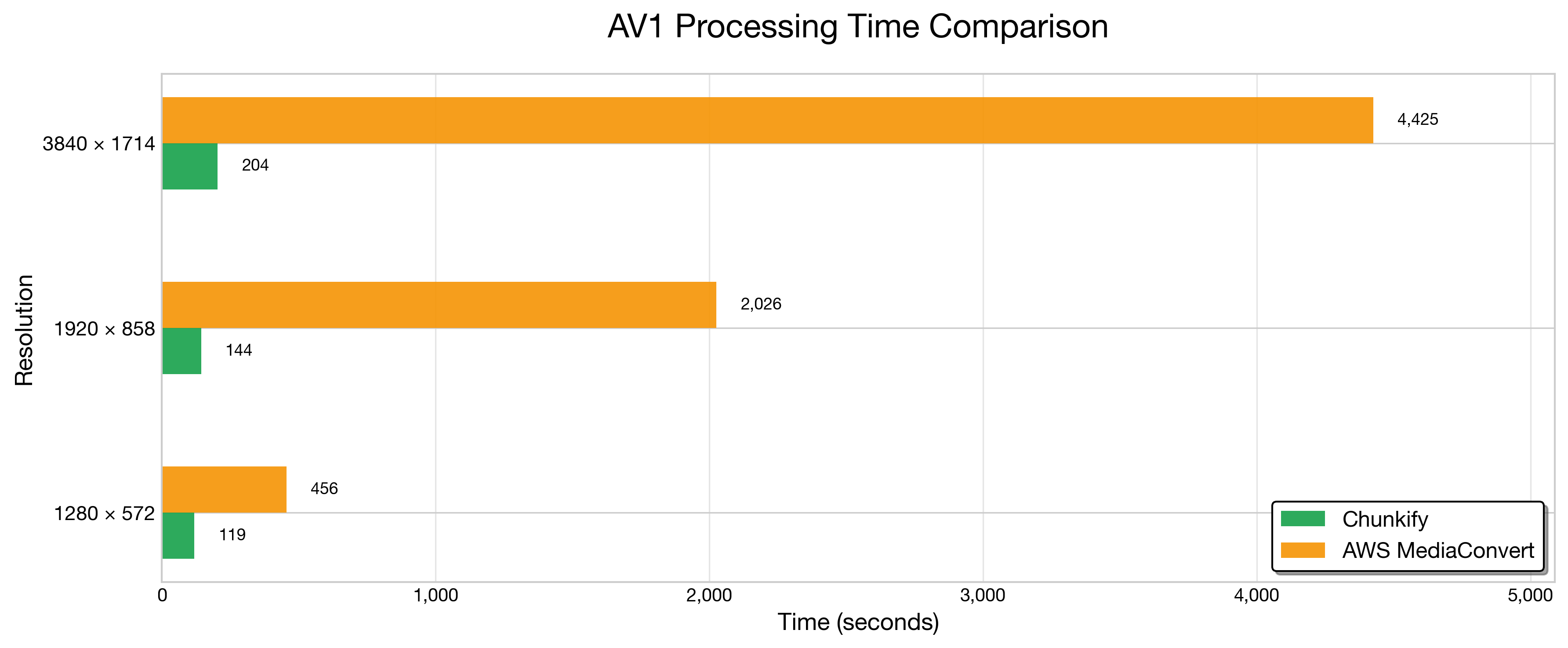
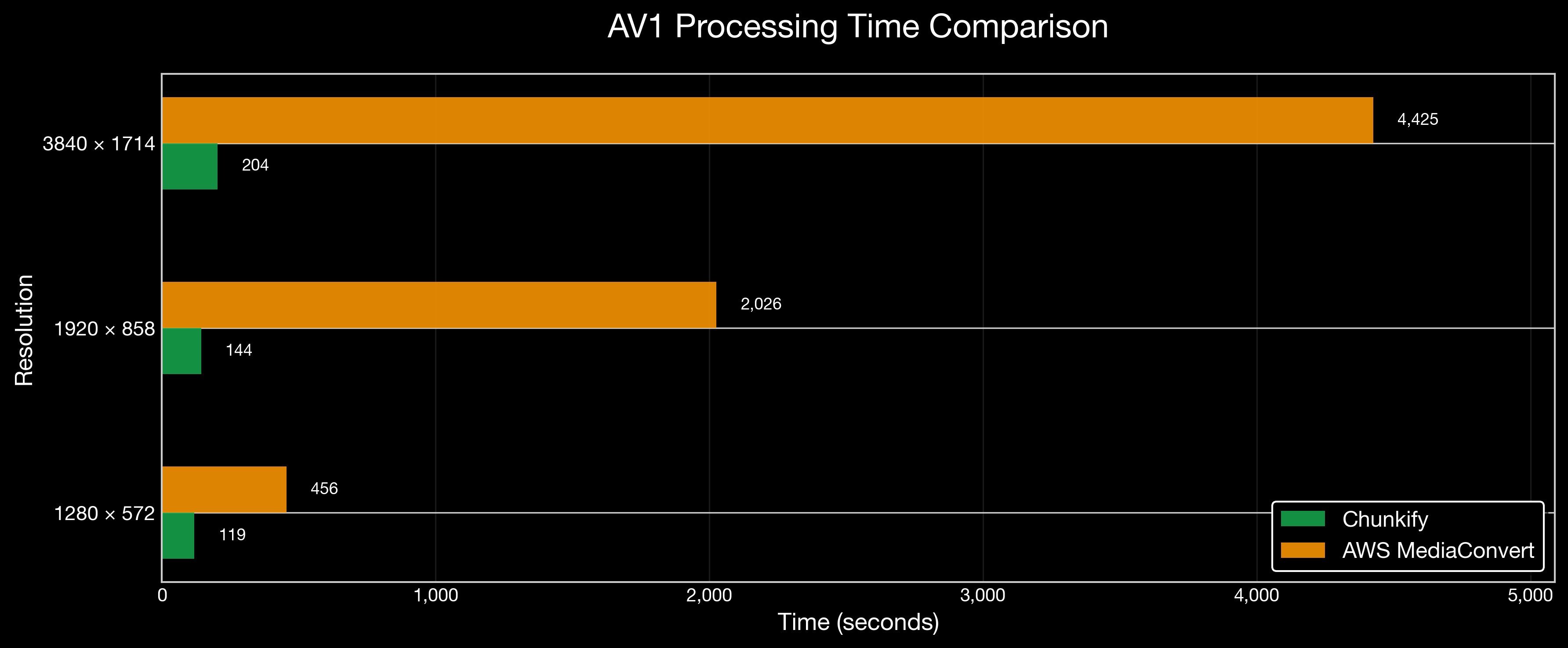
AV1 transcoding demonstrates the largest performance gap, with Chunkify completing jobs 3.83x to 21.69x faster:
| Resolution | Chunkify time (s) | AWS time (s) | Speedup |
|---|---|---|---|
| 1280 × 572 | 119 | 456 | 3.83x |
| 1920 × 858 | 144 | 2,026 | 14.07x |
| 3840 × 1714 | 204 | 4,425 | 21.69x |
Cost
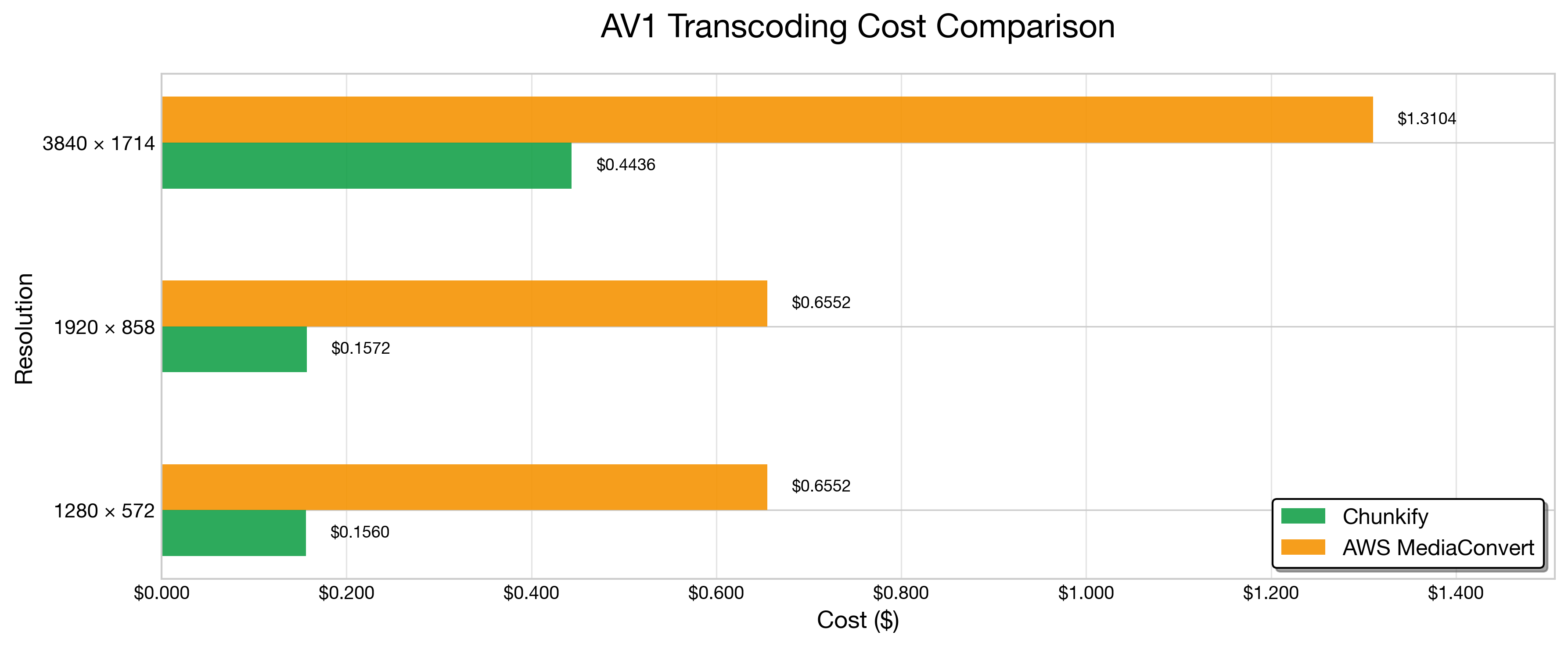
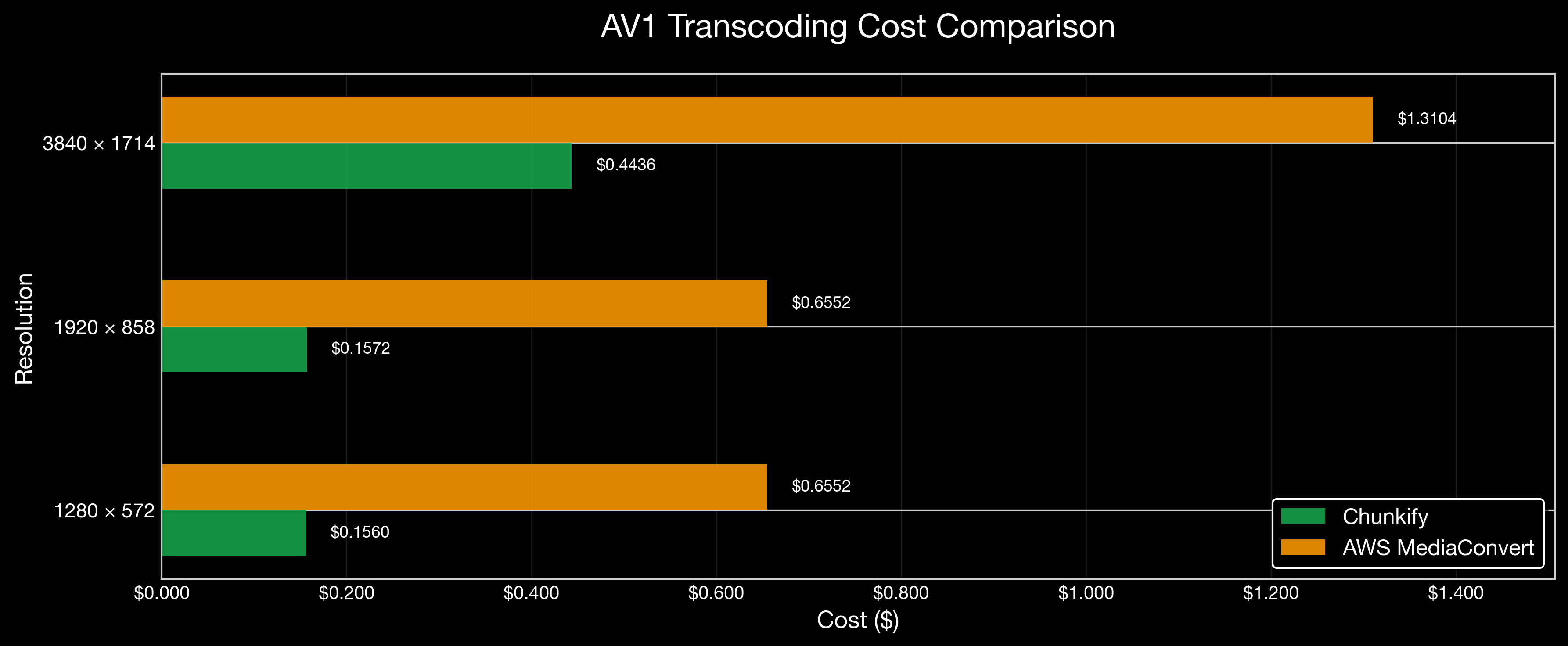
Chunkify costs 66% to 76% less for AV1 transcoding:
| Resolution | Chunkify cost ($) | AWS cost ($) | Cost savings |
|---|---|---|---|
| 1280 × 572 | $0.1560 | $0.6552 | 4.20x cheaper (76%) |
| 1920 × 858 | $0.1572 | $0.6552 | 4.17x cheaper (76%) |
| 3840 × 1714 | $0.4436 | $1.3104 | 2.95x cheaper (66%) |
Quality
| Resolution | Chunkify size (MiB) | Chunkify average bitrate (kb/s) | Chunkify mean VMAF | AWS size (MiB) | AWS average bitrate (kb/s) | AWS mean VMAF |
|---|---|---|---|---|---|---|
| 1280 × 572 | 151.9 | 1,734 | 87.31 | 129.0 | 1,472 | 82.31 |
| 1920 × 858 | 240.9 | 2,750 | 92.91 | 349.0 | 3,984 | 93.76 |
| 3840 × 1714 | 422.2 | 4,819 | 96.06 | 662.0 | 7,556 | 96.63 |
Summary
AV1 delivers the largest performance and cost advantage for Chunkify: it is dramatically faster (3.83x to 21.69x) and substantially cheaper (66% to 76%). At 1920 × 858 and 3840 × 1714, Chunkify produces files that are 31.0% and 36.2% smaller, with mean VMAF within 0.85 points of AWS. At 1280 × 572, Chunkify scores 5.00 VMAF points higher with a larger output file.
Conclusion
For quick reference, here is the compact summary across all tests:
| Codec | Resolution | Speedup | Cost savings | Chunkify mean VMAF | AWS mean VMAF |
|---|---|---|---|---|---|
| H264 | 1280 × 572 | 2.81x | 1.20x (17%) | 88.62 | 84.99 |
| H264 | 1920 × 858 | 2.61x | 1.13x (12%) | 93.50 | 94.17 |
| H264 | 3840 × 1714 | 6.26x | 1.10x (10%) | 96.58 | 97.63 |
| HEVC | 1280 × 572 | 2.49x | 1.82x (45%) | 88.62 | 88.50 |
| HEVC | 1920 × 858 | 3.36x | 1.09x (8%) | 93.70 | 93.98 |
| HEVC | 3840 × 1714 | 4.75x | 1.26x (21%) | 96.73 | 97.42 |
| AV1 | 1280 × 572 | 3.83x | 4.20x (76%) | 87.31 | 82.31 |
| AV1 | 1920 × 858 | 14.07x | 4.17x (76%) | 92.91 | 93.76 |
| AV1 | 3840 × 1714 | 21.69x | 2.95x (66%) | 96.06 | 96.63 |
Speed: Chunkify completes every job faster than AWS MediaConvert across all codecs and resolutions. The performance advantage increases with codec complexity, with AV1 showing the largest gap, up to 21.69x faster at 4K resolution. This speed advantage is enabled by Chunkify's parallel processing architecture to process video segments concurrently, a capability not available in AWS MediaConvert's standard configuration.
Cost: Chunkify is cheaper in every tested configuration. Cost savings range from 8% to 76% depending on codec and resolution.
Quality and output size: Chunkify records higher mean VMAF in three of nine comparisons. In the other six, mean VMAF remains within 1.05 points of AWS. Chunkify produces the smaller file in six of nine configurations; the 1280 × 572 H.264 and AV1 runs trade larger files for substantially higher mean VMAF.